Denmark gets treated as a long weekend. People fly to Copenhagen, eat extremely well for three days, look at some furniture, and go home impressed. Nothing wrong with that trip. But it's a bit like flying to the States and only seeing Manhattan — accurate, incomplete, and it misses the part of the country the Danes actually go to.
Copenhagen, by bicycle
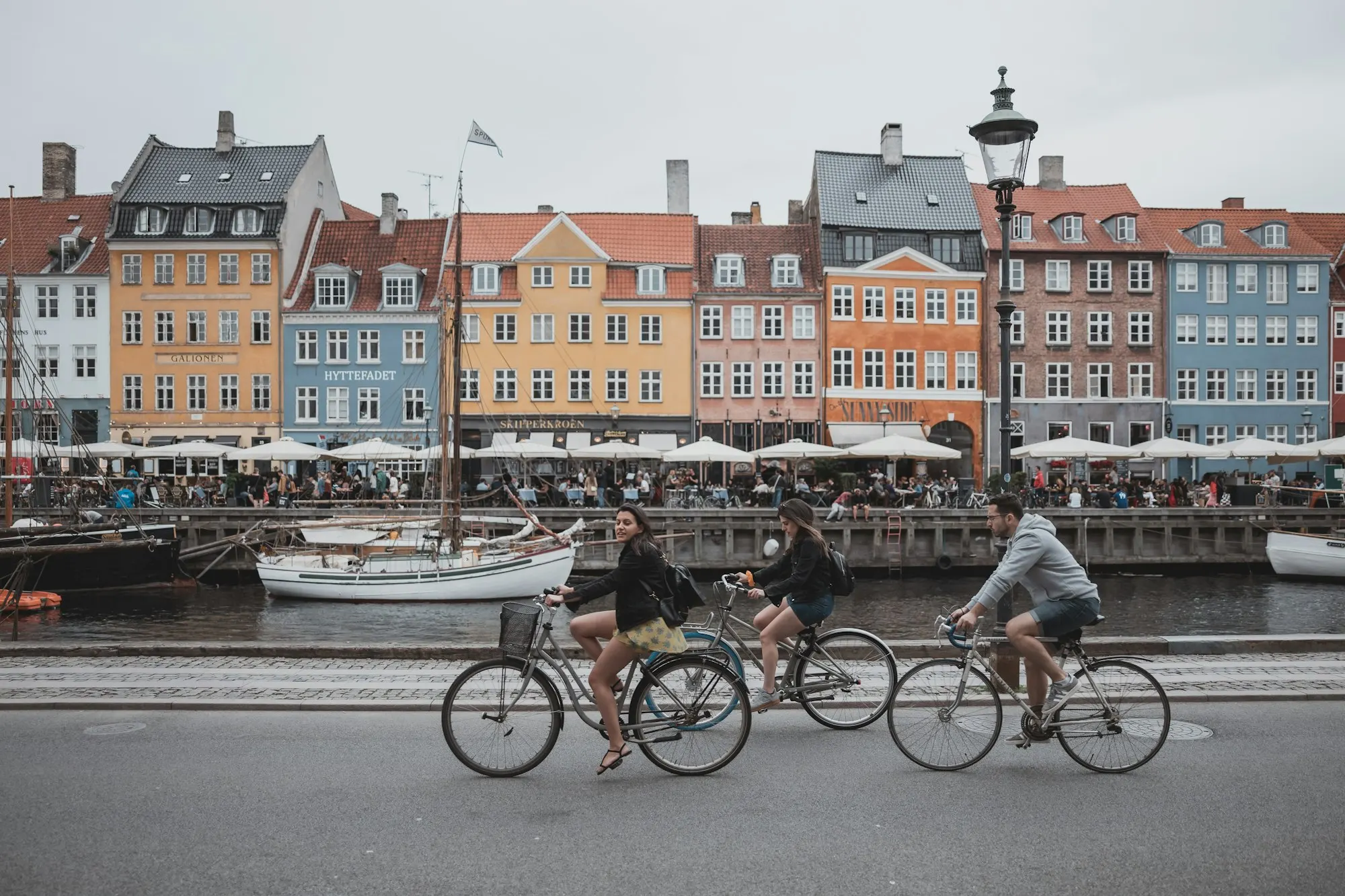
Give Copenhagen four nights and use a bicycle. The city is flat, the bike lanes are separated from traffic, and the whole thing is designed around the assumption that you're not in a car. Reserve one of those days for the Louisiana Museum of Modern Art, which is thirty-five minutes north by train at Humlebæk and is, for our money, the best-sited museum in Europe — a low modernist building strung along a lawn above the Øresund with a sculpture park running down to the water. Go on a clear day and give it four hours.
Møn and the chalk cliffs
Then leave. Two hours south is Møn, an island with the only real cliffs in Denmark: Møns Klint, white chalk falling four hundred feet into water that turns turquoise in the right light. The island is also a certified dark-sky reserve, which in a country this flat and this far north makes for genuinely startling stargazing between September and March.
Bornholm, the food island
Further out — a proper journey, ferry or a short flight — is Bornholm, sitting closer to Sweden and Poland than to Denmark. It is the country's food island: smokehouses on every headland, a serious ceramics tradition, round fortified churches, and the ruins of Hammershus on the northern cliffs. Three nights. Rent a bike, eat smoked herring for breakfast, and accept that you will want to stay longer.
Aarhus and Skagen
On the mainland, Aarhus is the counterweight to Copenhagen and about three hours by train. It's a university city, so it runs younger and cheaper, and ARoS is worth the trip on its own — the museum is topped by Olafur Eliasson's circular glass walkway, which cycles through the entire spectrum as you walk it. From there it's another two and a half hours north to Skagen, the very tip of the country, where the North Sea and the Baltic meet in a visible line of colliding water and the light was strange enough to produce its own school of painters in the 1880s.
When to go
Timing is unusually decisive here. May through early September is the window: the days run long — around seventeen and a half hours of daylight at midsummer — and the whole country moves outdoors. Denmark in November is dark by four in the afternoon, which some people love and most people should be warned about.
Getting around, and eating
Two practical notes. First, the trains are excellent and you do not want a car until you leave the mainland, at which point you very much do — the islands are built around driving and cycling, not public transport. Second, on food: Copenhagen's reputation rests on a handful of restaurants that book out months ahead, and chasing them can eat your whole trip. The better move is one serious meal booked early and the rest of the week spent on smørrebrød, bakeries, and the harbour food halls, which are where Danes actually eat and where the country's cooking is more honestly represented.
How long to give it
Ten to twelve nights gets you Copenhagen, one island, and either Aarhus or Skagen. Fourteen gets you all of it without hurrying, which in a country this compact is a genuinely different experience from the same route done in ten.